How do you identify the best coffee?
discover the finest speciality coffees
Before it gets to your cup, coffee is subject to multiple gradings at every stage. This is a rigorous and continuous process undertaken at all stages of the supply chain — by farmers, harvesters, processors, tasters and roasters. Their combined efforts ensure that you receive the best coffee that meets the high standards required for speciality coffee.
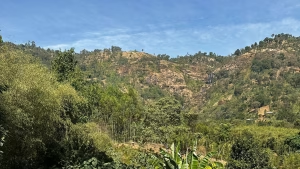
grading coffee starts on the bush
Selective Harvesting
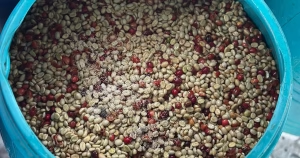
Speciality coffee berries are selectively harvested. This hand-picking ensures only the perfectly ripe cherries are taken from the bush, leaving the unripe ones for a later date.
Floating the Cherries
Often, immediately after harvest, cherries are put in water tanks. Good dense cherries sink, while under-ripe, diseased or over-ripe cherries float to the top and can be easily removed.
Visual check and sorting
Throughout the drying process, the coffee beans are carefully turned and picked over to remove any defects.
Grading at the dry mill
Once dried, the green beans are hulled at the dry mill, removing the last of their protective layers. At this point they are examined again for colour, size and defects. This ensures only the very best beans are sent for cupping.
Q-Grade professional tasters
Q-Graders represent the world’s best coffee tasters. They are licensed, trained professionals with a vast depth of knowledge about coffee and are experts at coffee cupping. You can compare them with Master Sommeliers for wine.
There are only around 135 Q-Graders in the UK as it is a highly specialised, high-level qualification for industry professionals. Maintaining the certification requires the Q-Grader to retake calibration tests every three years.
Improvements to SCA Cupping standards
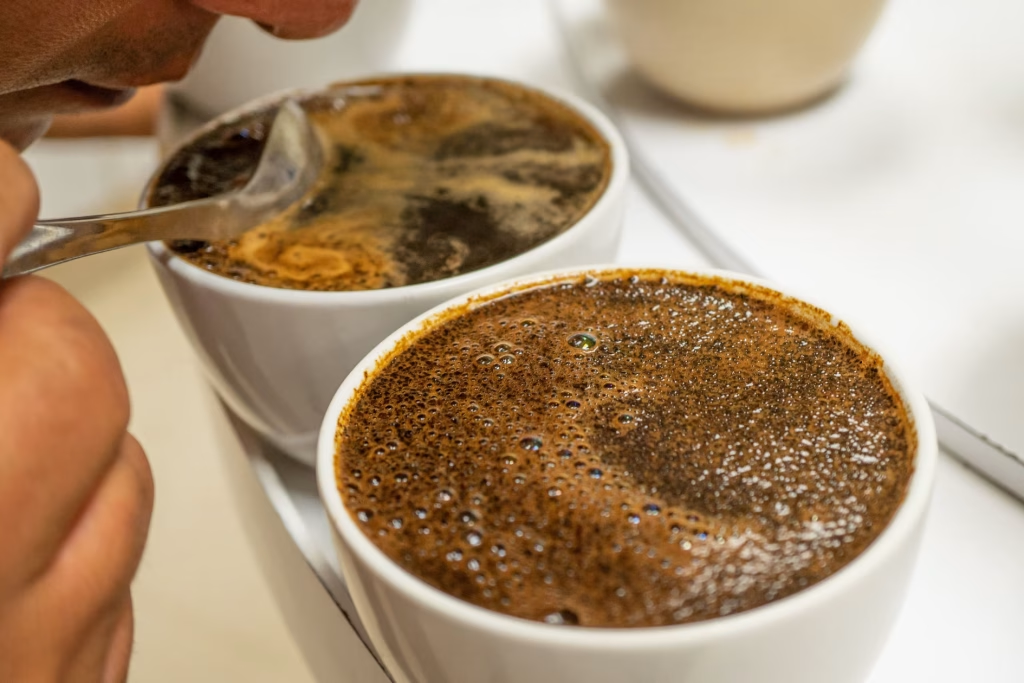
Coffee cupping is all about tasting the roasted coffee beans. The professionals follow a set protocol created by the Speciality Coffee Association to ensure that all coffee beans have been through the same process. This eliminates the variables so they can really focus down on the characteristics of the specific beans. This was updated in 2024 with the launch of the Coffee Value Assessment, which advances the science standards and practices behind coffee evaluation.
Explore the process below, flipping each image for a detailed explanation:
Roast
Beans are roasted to a ‘Medium/ Medium-light’. This is 63-65 on the Agtron Scale
Cool
After roasting, the beans are left to air cool naturally until they reach 20°C
Rest
Once cool, the beans are rested for 8-24 hours in airtight containers in a cool dark place
Cups
5 identical vessels are required that hold 200-350ml and have a rim diameter of 75-90mm Ø
Ratio
Beans are weighed. There needs to be exactly 8.25g of coffee for every 150ml of water
Grind
For cupping, beans are ground until 70-75% pass through a sieve size 850µm.
Grounds
Before adding water, the aroma of the grounds are assessed
Bloom
Brewing involves filling the glass to the brim with 93°C water. The grounds bloom and form a crust
Crust
The aroma of the crust is assessed and again after stirring 3 times to break the crust
Skim
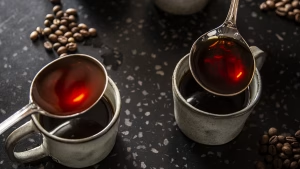
After breaking the crust, 2 spoons are used to skim floating grounds and oils from the surface
Cool
Once skimmed, coffee is allowed to cool to 70°C degrees before liquoring
Liquor
Liquor the coffee (3+ rounds) by slurping coffee from a spoon to cover the palette
What goes into the cupping score
- Fragrance: Prior to brewing a fragrance assessment of the dry grounds is made.
- Aroma: The aroma of the brewed coffee is assessed just after brewing and after the “crust’ is broken.
- Flavour: The flavour includes the taste and the smell while the brew is in the mouth. Often the best coffee will show a distinct and well-developed note.
- Aftertaste: When the coffee has been swallowed the aftertaste is considered.
- Acidity: The perception of sour taste in intensity and character such as citrus, blackberry or tropical fruits.
- Sweetness: The perception of sweetness provoked by the brew such as toffee, vanilla, elderflower or honey.
- Mouthfeel: How the brew feels in the mouth such as weight and texture — tea-like or smooth and silky.
- Overall: A subjective perspective of general quality as a whole including balance and preference.
- Uniformity: The consistency of the flavour across the 5 samples should be uniform.
- Defect: A check to ensure that there are no undesirable characteristics in flavour.
High cupping scores given to the best coffees
Each section is given a grade of 1-10 which is added up for all 5 cups and provides a Cupping Score.
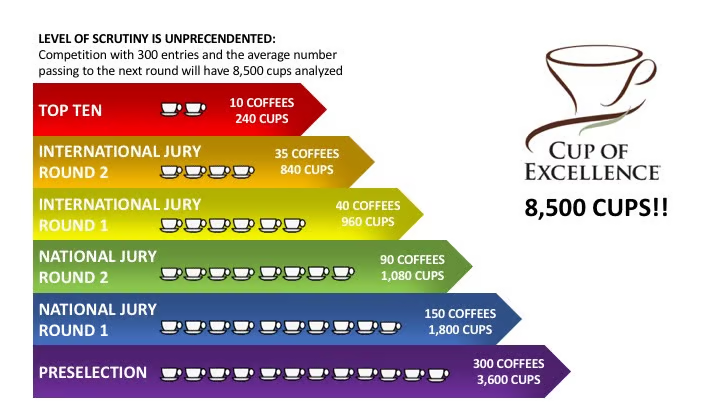
The top spot is taken by the Cup of Excellence. Scoring is not linear, with significant improvements required to achieve grades between 80-90. Anything above 85+ is excellent:
Cupping score | Grade |
|---|---|
90-100 | Speciality – Competition |
85>90 | Speciality – Excellent |
80>85 | Speciality – Very good |
>80 | Commercial/Commodity |
Cupping is not just for Q-graders
It can be done on many levels: the professionals do it to evaluate harvests, roasters to fine tune their roasting recipe, and consumers can do it as a way to explore and enjoy a new experience. If you would like to have a go, read How to Host Your Own Coffee Cupping.
The effect of the roaster
Roasting can greatly affect taste as it controls acidity, sweetness and bitterness. During roasting, acidity reduces whilst bitterness slowly increases. Incorrect roasting levels can cause problems such as underdeveloped or burnt beans. The roaster balances the level of acidity and bitterness to enhance the sweetness and intrinsic flavours of the coffee bean.
Our coffees are cupped several times to refine the roasting recipe until we are sure that we are getting the very best out of our beans!